The Hardware OS, in one page
What this operating system looks like when it's working
The concrete test is not a metric. It is a set of people doing their jobs without friction.
Your exec can leave Friday afternoon. Not because the program is done, but because the gate status is real, the risk register surfaces what would otherwise surprise them, and every open decision has a named owner and a date. They are not anxious because they are not holding the program truth in their head. The one-page status is holding it for them, and they trust it.
Your PM stops asking "where are we?" A PM who trusts the schedule and the risk log shifts from chasing daily status to clearing real blockers. The artifacts answer the question before it is asked. That is not a nice-to-have — it is the measurable output of Layers 3 and 4 working. A PM who stops pinging is a PM who has something reliable to read.
Your engineering team makes decisions, not presentations. When requirements are managed hypotheses with visible evidence, when gate packets come from live records instead of slide heroics, and when the schedule is built from real dependencies, the team spends its time on the technical problem — not on reconciling contradictions between what the slides say and what the test floor sees.
These are the outcomes the OS is designed to produce. The chapters are the mechanism.
Five operating layers produce these outcomes. Knowing the layer a chapter belongs to tells you what it is for, and what it is not for.
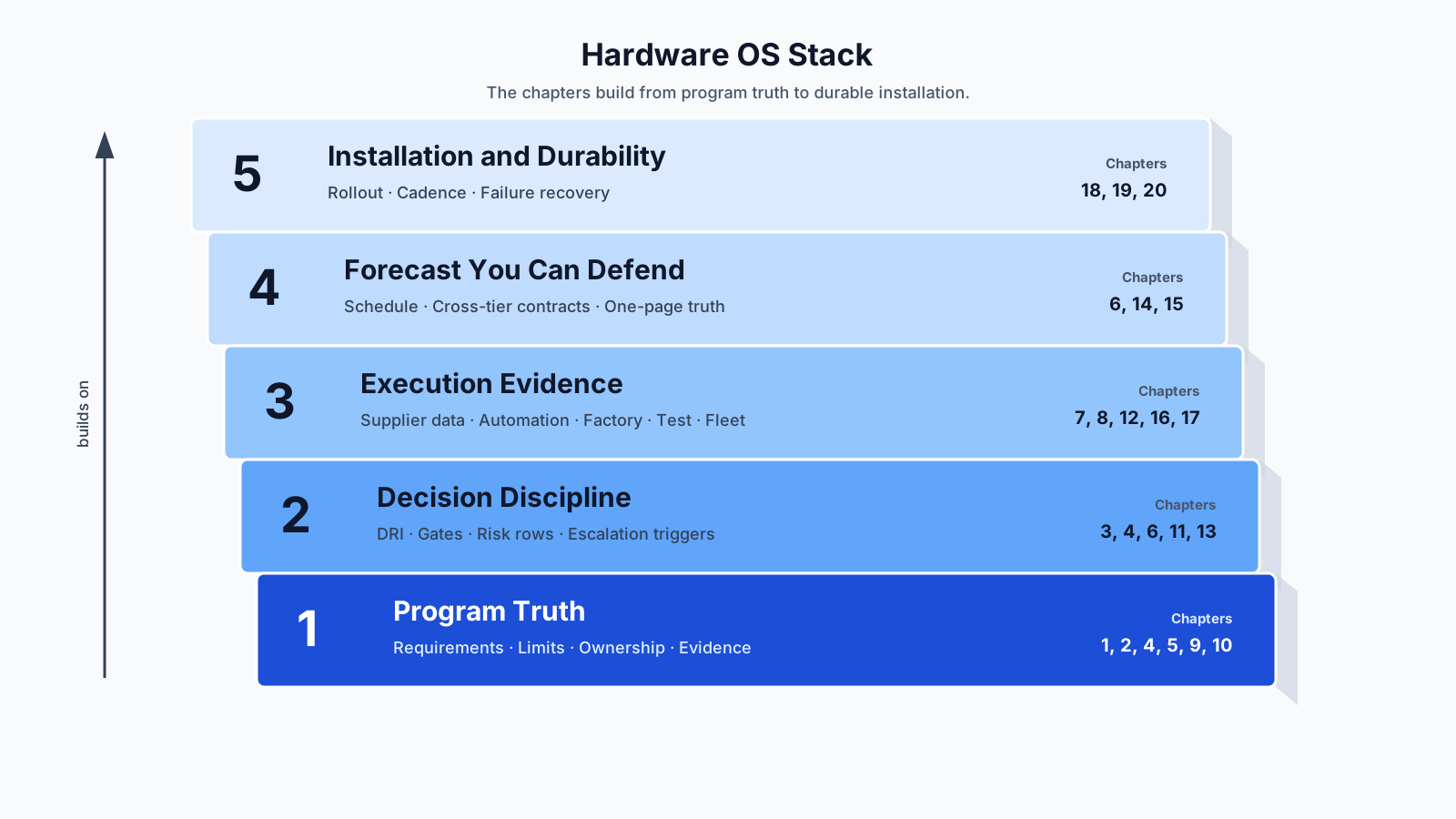
| Layer | What this layer guarantees | Ch. |
|---|---|---|
| 1. Program truth | One source of truth, one ownership rule, requirements as managed values, decisions as records | 1, 2, 4, 5, 9, 10 |
| 2. Decision discipline | Named owner for every open decision; gates entered as decisions, not reviews; risk rows that can trigger a mitigation action | 3, 4, 6, 7, 11, 14 |
| 3. Execution evidence | Evidence from the test floor, supplier, and fleet that is traceable to a requirement and current enough to change a decision | 12, 13, 16, 17 |
| 4. Forecast you can defend | Schedule from real dependencies, tier obligations made visible, executive one-page truth | 6, 8, 15 |
| 5. Installation and durability | Predictable OS install sequence; cadence that survives personnel changes; named scope limit so the OS does not overpromise | 18, 19, 20 |
A chapter can appear on more than one layer when its mechanism genuinely spans them. Gates show up in decision discipline and in forecast because a gate decision both changes a controlled baseline and moves the forecast. Automation at concept (Ch. 7) belongs in decision discipline, not execution evidence: it fixes access, presentation, and traceability fields before the line is producing population-scale floor and fleet returns. The layer is not a category; it is a declaration of what the chapter must guarantee for the OS above it to hold.
Reading straight through, the layers assemble in order: truth first, decisions about truth, evidence that supports the decisions, a forecast that holds the evidence and decisions together, then finally the install plan that makes the whole system survive contact with the next program.
How to use this map
Use this page as a map you come back to. Each chapter states which mechanism it introduces; this page says which layer that mechanism lives in. If a chapter feels repetitive, check which layer it is on — it may be introducing the same vocabulary in a different operating context (a different scale, a different tier, a different phase of the program).
If you are in a specific role:
- Engineering lead: start with Layer 1 (program truth). Everything else is scaffolding on top of that foundation.
- PM: Start with Layer 4 — the schedule, cross-tier contracts, and one-page status are the artifacts a PM reads and defends daily; Layer 2 explains why the gates and risk rows that feed those artifacts are built the way they are.
- Executive or sponsor: the one-page truth (Ch. 6), cross-tier contracts (Ch. 15), and schedule integrity (Ch. 8) are the direct executive-facing chapters. The chapters in Layers 1 and 2 explain why those artifacts hold when the program is under pressure.
- Hardware founder or technical lead running their own program: start with Layer 1 — the gap between a technically strong founder and a program that survives the first handoff or scale-up is almost always missing ownership records and requirement locks, not missing technical depth. Layer 5 (Ch. 18–20) names where the OS does not substitute for regulated or specialist obligations.